The first three chapters of the book were written by João Quartim de Moraes. The opening chapter traces the origins of the Indigenous peoples of the New World and the expansion of transcontinental trade and maritime exploration beginning in the eleventh century, in order to examine the consequences of the first encounters between Europeans and Indigenous peoples in the Americas. The author devotes substantial attention to Bartolomé de las Casas, a Spanish Dominican friar who is rarely discussed in this debate and who became a critic of Indigenous peoples’ enslavement after witnessing the atrocities that marked the conquest and colonisation of the Americas. The second chapter links the formation of the Spanish imperial state to the rise of religious intolerance in Spain. Prior to the end of the fifteenth century, Judaism, Islam, and Catholicism coexisted within Spanish borders. Yet 1492 represented a decisive historical watershed that brought this coexistence to an end as a result of three major events. First, the Spaniards reclaimed territories that had formerly been under Islamic rule. Second, the “Most Catholic Monarchs” issued a decree banning Judaism. Finally, in October of that same year, Christopher Columbus arrived in the Antilles. In this way, a powerful and intolerant empire emerged, one that carried these characteristics into the colonisation of the Americas and further reinforced them throughout the colonial process. The third chapter highlights the theological debate on the enslavement of Indigenous peoples. In this section, the author examines the novel legal and philosophical questions raised by the conquest of the New World, such as the limits of papal and imperial authority, and whether Indigenous peoples were slaves by nature (103). Within this context, the debate between Bartolomé de las Casas and Ginés de Sepúlveda is presented as pivotal, contributing to the passing of new laws under Charles V and Philip II that prohibited the enslavement of Indigenous peoples in the New World.
The fourth and fifth chapters were written by Ligia Osorio Silva. The fourth chapter examines representations of the New World and their impact on European ideologies. An early portrayal of the New World by Europeans, based on accounts of seemingly happy Amerindian peoples unfamiliar with private property, inspired the myth of the “noble savage” (149). The “noble savage” lived communally, without private ownership of land, and embraced a concept of wealth that differed fundamentally from the European one. Thus, whereas in the sixteenth century Indigenous societies were often portrayed as having created a paradise on earth, this fascination and admiration gradually gave way to the valorisation of modern norms and customs, including the right to private property. From this new perspective, Indigenous peoples were now depicted as savage and cruel, and unclaimed lands in the Americas were portrayed as territories available for appropriation.
The fifth chapter examines the relationship between imperial Brazilian policies and French emigration to Brazil. The interests of Brazil and France appeared to converge in the mid-nineteenth century. France sought to expand trade with Brazil and saw the emigration of French citizens as a possible means of doing so. Brazil, through the enactment of the Land Law, created policies regarding land possession by immigrants that were considered essential for attracting foreigners to settle in the country. Moreover, French economists advocated emigration to other countries as a solution to poverty in France, while the Brazilian government projected an idealised image of Brazil by presenting opportunities that did not exist in reality. Nevertheless, despite these efforts, neither trade between the two countries nor French emigration to Brazil increased significantly during the period under review. These efforts were neutralised by French political forces, especially those led by small landowners, and by the dominance of large landowners in Brazil.
The book’s main contribution lies in showing that the novelty the American continent represented for Europe was inseparable from the violence of the colonial process. Everything that took place in the New World was perceived as a novel experience. Yet these novelties stemmed from the violent nature of how Europeans interacted both with Indigenous peoples native to the Americas and with Africans who were captured and forcibly sent to the Americas. On this basis, the fourth chapter of the book reconstructs three intellectual shifts that began with the Europeans’ arrival in the New World: the understanding of the status of Indigenous peoples, the justification of Indigenous slavery on the basis of Christian doctrine, and the conception of private property.
The shift in the perception of Indigenous peoples — from the “noble savage” to the barbarian — belongs to a broader intellectual debate that began with Rousseau and reached its fullest expression in the works of Hegel and Humboldt. Respect for the figure of the noble savage was inherently linked to respect for his communal way of life, which rejected the existence of private property. Thus, the collapse of the noble savage myth coincided with the imperative to impose rules and policies establishing the right to private property in the Americas.
With regard to the changing justification of Indigenous slavery according to Christian precepts, it is noted that biblical texts made no reference to Amerindians and that the Catholic Church never strongly opposed slavery, explicitly allowing for it in the case of African peoples. Nonetheless, the critique advanced by Catholic missionaries in the Spanish colonies during the sixteenth and seventeenth centuries is highly significant. Their efforts led to the intervention of Charles V, who promulgated the New Laws in defence of Indigenous peoples in 1542.
The impact of the earliest accounts of life in the New World gave rise to two enduring concepts. On the one hand, the new European visitors propagated a vision of a Golden Age; on the other hand, they later disseminated depictions of a brutish way of life, deprived of the benefits of civilisation. In accordance with the former perception, Montaigne’s interpretation gave rise to the myth of the noble savage, highlighting natural innocence and affirming the desirability of being close to nature. Through this lens, the absence of private property was seen as the explanation for the natives’ happy existence.
However, European natural law theorists later understood the myth as more of an unattainable ideal. Locke argued that property was a fundamental, natural right. Individuals came together through a social contract and created the state, among other reasons, in order to preserve this right. This idea developed alongside new trends in land use that opposed arrangements based on oral customary practices and favoured written contractual agreements instead.
In the nineteenth century, especially in the United States, the application of contract law in the New World granted new occupants of the land the right to property over it. This right was considered legitimate because it led to the incorporation of those lands into the capitalist system of production. In conclusion, the practices that consolidated absolute property rights were instrumental to the capitalist development of the United States and Europe, while simultaneously encouraging the annihilation and dispossession of native populations in the New World.
Grounded in an extensive classical bibliography drawing from the fields of history and philosophy, this book delves into contemporary debates reflected in current literature in these two academic areas. Despite engaging with a wide range of authors and interpretations, the text remains exceptionally clear and consistent. It is exceptionally well written, allowing for a fluid and engaging reading experience.
Novo Mundo: Metamorfoses da Colonização establishes itself as an important new reference for courses on the history of early modern Latin America because it highlights the significance of the philosophical debate that emerged in the Iberian Peninsula with the onset of the colonisation of the Americas. It also provokes discussions that extend both backward and forward across the chronological framework established by João Quartim de Moraes and Ligia Osorio Silva. This work presents the dynamics of European colonisation in the Americas and draws inferences about the influence of the colonial past and slavery on contemporary Brazilian society. In summary, this is a book that has already become — and will undoubtedly continue to be — an indispensable resource for both instructors and researchers.
*This review is a translated and slightly modified version of one published in Portuguese in the journal História Econômica e História de Empresas.
10 August 2026
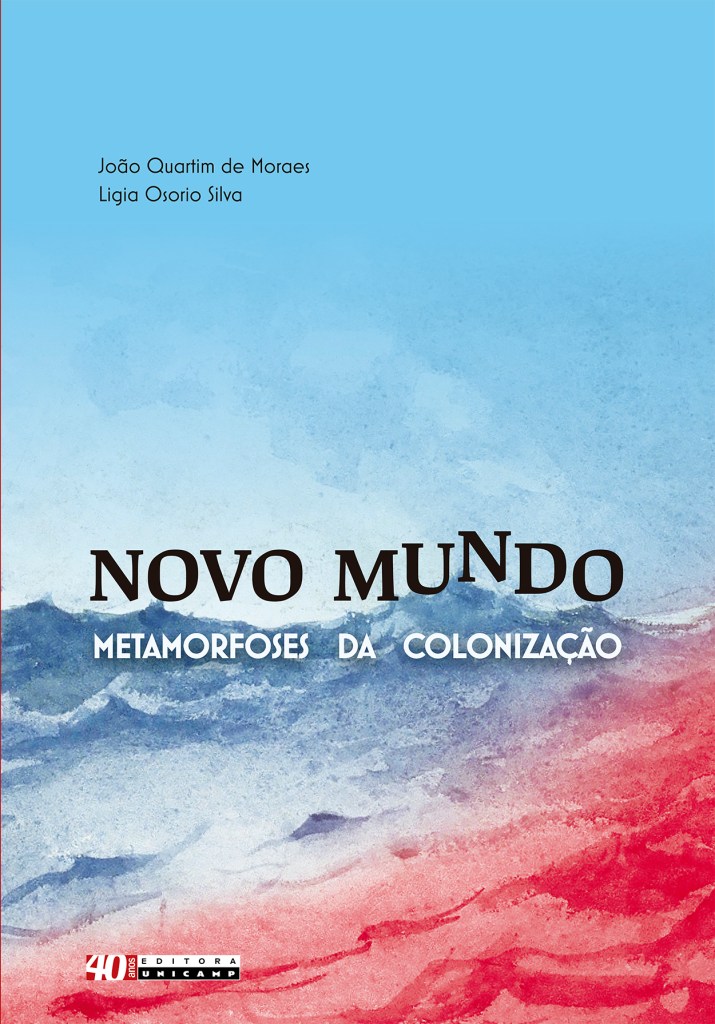
Novo mundo: metamorfoses da colonização
Autores: João Quartim de Moraes e Ligia Osorio Silva
ISBN: 9788526815711
Edição: 1ª
Ano: 2022
Páginas: 264
Dimensões: 16 x 23 cm
 Blog da Editora da Unicamp